


ConstrucThor · Smart Buildings · Genk, Belgium
Real answers for climate-neutral renovation at a unique living lab
7,500 individual control points, proven under real, measured conditions.
The project
7,500+ control points, one data layer
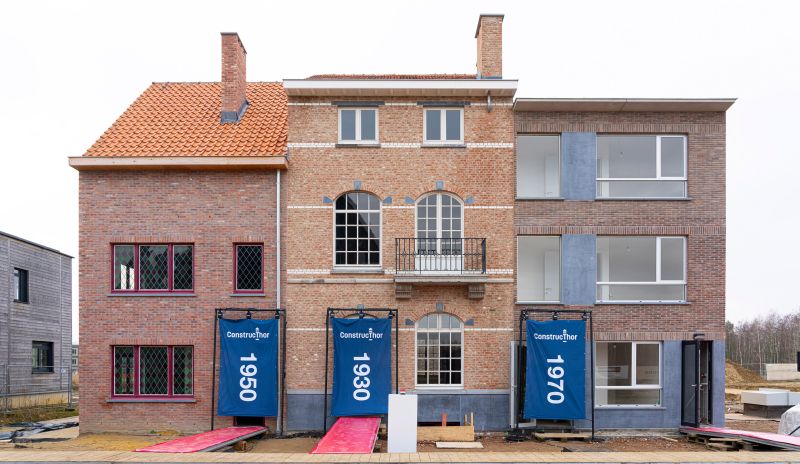
How Boolean turned three renovation typologies, an office building and a technical backbone into one control layer where KU Leuven's researchers can override any valve, sensor or setpoint, without disrupting the rest of the site, and without redesigning it every time the research moves on.
A normal building management system is built to run itself: the opposite of what a research site needs. Across three renovation typologies, an office building and the technical backbone, KU Leuven's researchers had to be able to override any single valve, sensor or setpoint without disrupting the rest of the site, and keep that access as the research questions themselves keep evolving over the years ahead. Most off-the-shelf building control fights you the moment you try to bypass its own logic.
Result
What we did
We built the full control layer on Beckhoff hardware: nine PLCs across three terraced houses and the office building, more than 7,500 control points, one central server. Every component (HVAC, lighting, shading, metering, the backbone's energy and water flows) sits on the same open-standards data layer, addressable on its own rather than folded into a closed sequence. That is what makes the site future-proof: a new sensor, a new experiment or the next research phase plugs into the same layer instead of triggering a redesign. Around 250 network ports and a virtualised server environment carry the platform, behind a firewall that separates the OT network from research and office traffic.
How we delivered it
Every installation can be driven three ways: automatically, manually, or remotely by a researcher's own script or model, the mode that fits the experiment, without rewiring anything or waiting on us. Secure remote access lets KU Leuven and Boolean reach the site from outside. We delivered in step with the construction of the site, and the same architecture is what lets it keep growing: Boolean stays available for support and for whatever the next research phase adds, without starting over.
“We needed a partner who looked further than classic building control. Boolean was the perfect match.”
Tim Verhetsel · KU Leuven – EnergyVille, ConstrucThor
In detail
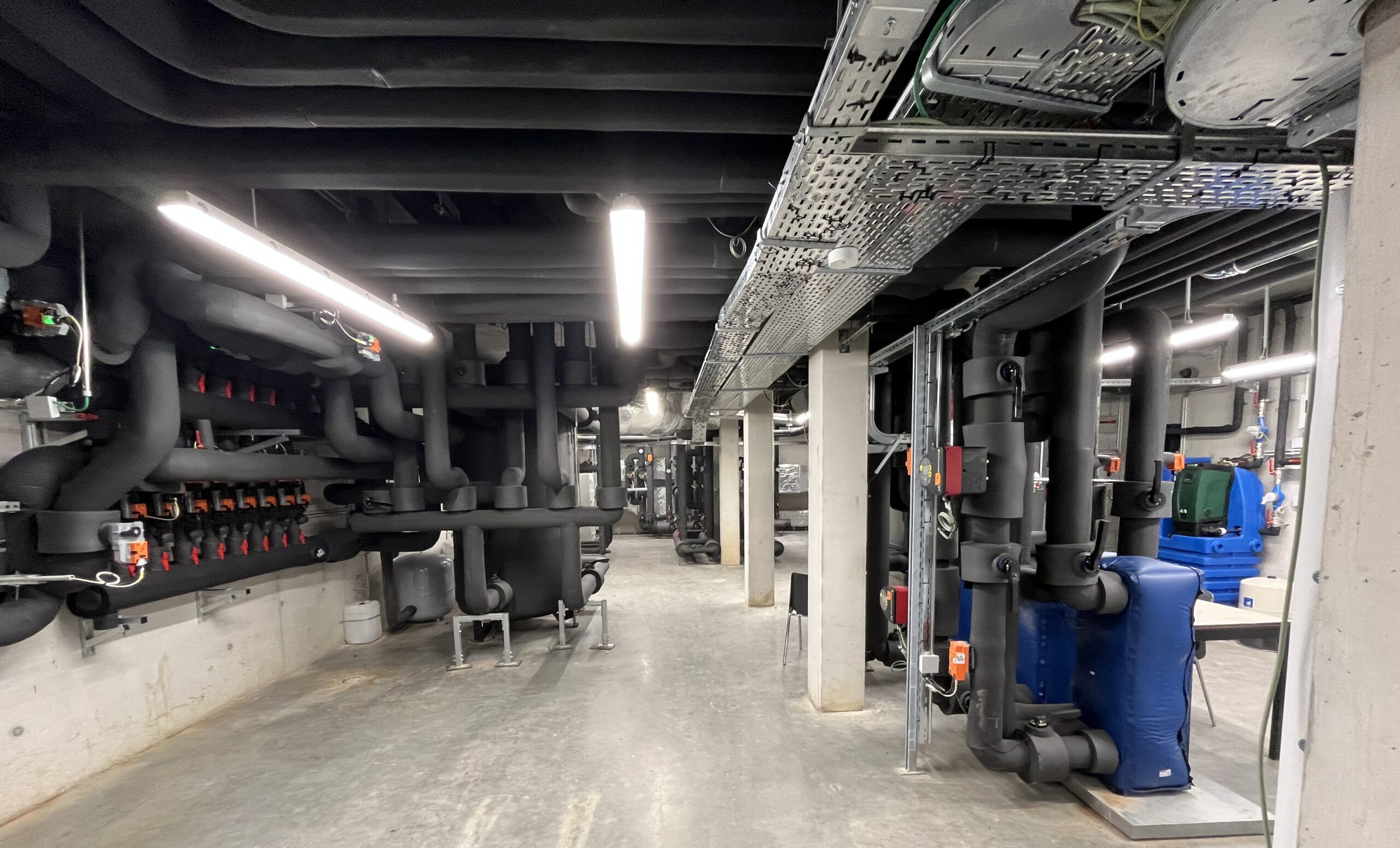
A basement that looks more like a small factory
How the control layer of ConstrucThor is put together, and what researchers do with it day to day.
Technical detail
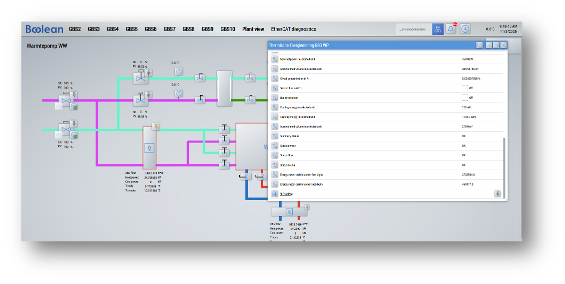
Nine Beckhoff PLCs cover three renovation typologies and the office building, with the technical backbone (heat generation, thermal and electrical storage, water flows) in the same architecture, on some 250 network ports and a virtualised server environment. More than 7,500 BACnet control points are captured locally and gathered on a central server, with DALI and KNX integrated for lighting and shading. A firewall separates the OT network from research and office traffic, and secure remote access lets researchers and Boolean reach the site without opening it up. Data is stored on site and exposed through APIs, so researchers read it into their own models and write setpoints back.
In daily use
KU Leuven researchers run three modes side by side: the building steers itself automatically, an operator drives an installation by hand, or an experiment takes control of individual parameters from outside. Measurements from the site can be held against the digital twin of the whole campus, so a simulation is never trusted blind. Because every controllable component is addressable on its own (valves, pumps, heat generation, ventilation, lighting, shading), an experiment can isolate one installation while the rest of the site keeps running normally, and a new one can be added without disturbing what's already there. The initial implementation is complete; Boolean stays available for support and for the extensions the next research phase brings.
Client

Companies involved



Ready to put your data to work?
We think along from the very first conversation. No standard answer, but a plan tailored to you.